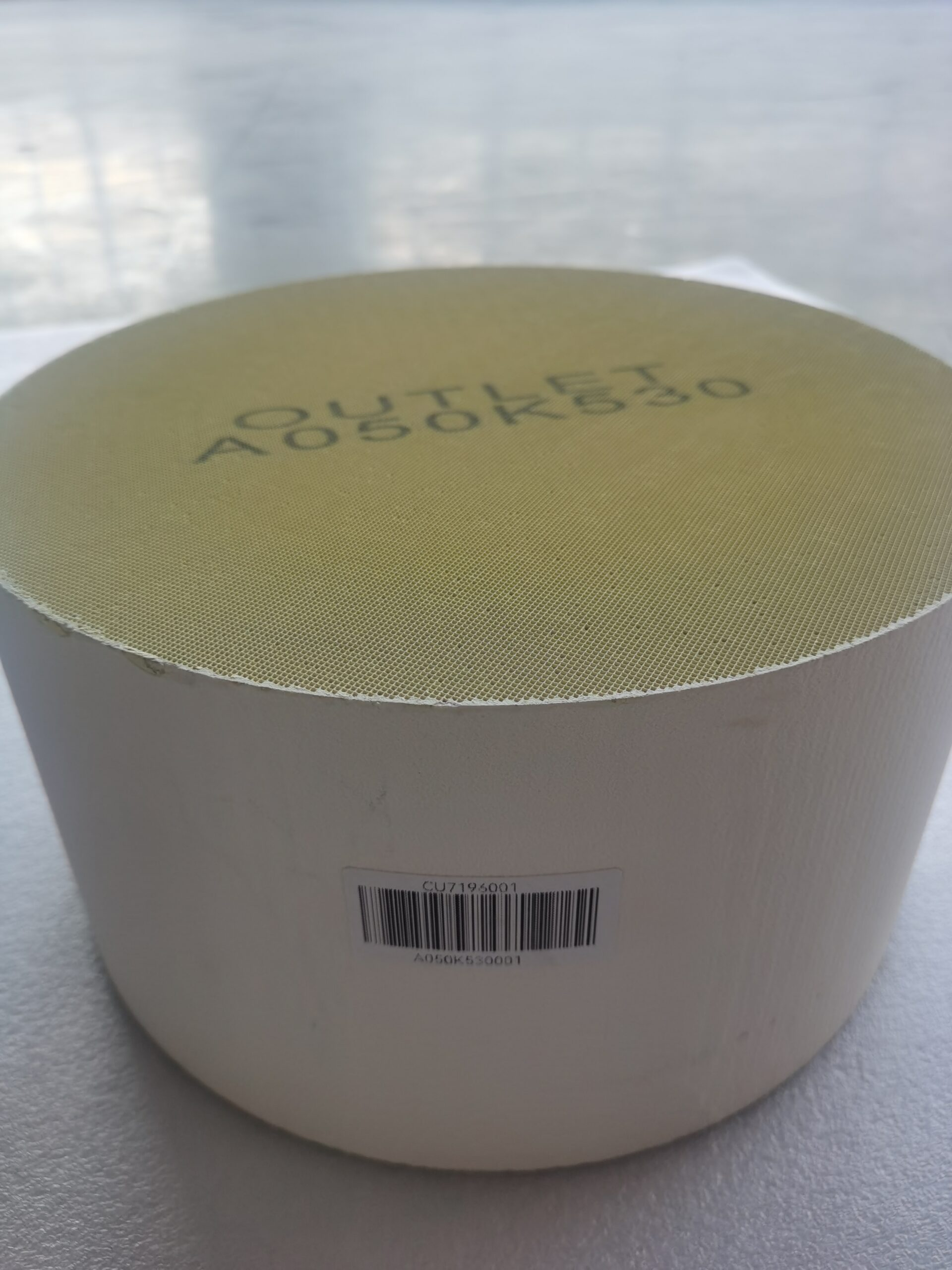
Exhaust that bypasses an active surface leaves part of an SCR catalyst unused, however suitable its formulation may be for NOx reduction. A vanadium oxide catalyst is one possible chemistry, but its useful contribution is not explained by the metal name alone. Temperature, ammonia supply, the NO/NO₂ balance, and the honeycomb carrying the active material all influence what reaches the tailpipe.
The question for an engine program is how that chemistry and structure work together. An active layer cannot convert a gas it does not contact, and a well-shaped flow path cannot replace catalytic activity outside the suitable temperature range. Vanadium-based formulations thus need to be evaluated as part of an SCR component, with their own operating limits and durability requirements.
Establish the NOx Reduction Conditions
In urea-SCR, ammonia derived from the injected reductant reacts with NOx over the catalyst, producing nitrogen and water. A nox catalyst must receive enough reductant, but dosing must also be controlled to avoid excess ammonia. Exhaust temperature governs reaction rates, and the proportion of NO to NO₂ affects the available pathways. These conditions can change within one engine duty cycle.
Activity can also change after thermal exposure and continued use. A fresh sample evaluated at one steady temperature cannot describe every future operating point. A vanadium oxide catalyst specification should therefore include relevant temperature distribution and an agreed condition for evaluating aged or conditioned material. The outcome is an application result, not a property that transfers unchanged between engines.
The NOx inlet profile should include concentration as well as temperature. High-load intervals may carry more NOx than longer low-load periods. Evaluating only average temperature can therefore conceal an important portion of the required reduction duty. The relevant question is whether the formulation works when the engine produces the NOx it must control.
Give the Chemistry a Suitable Honeycomb
The SCR honeycomb distributes exhaust across active surfaces while limiting pressure loss. Channel geometry and cell density influence contact and resistance; material stability determines whether those channels remain intact under temperature swings and vibration. A formulation selected for its chemistry still needs a substrate that can survive installation and preserve a usable flow path.
Neither a lower pressure drop nor a larger nominal area automatically means higher installed NOx conversion. Flow distribution, reductant mixing, temperature, and active formulation interact.
A test program should track both gas concentrations and pressure across the component, with the specimen’s geometry and coating identified. This keeps the contribution of structure visible without confusing it with the underlying SCR reaction.
Uneven flow can leave coated surface underused. Channel density and length influence residence time as well as pressure loss and thermal mass; the distribution of coating on that geometry affects the available reaction surface. Keeping the test unit’s substrate and coating consistent with the proposed component separates a formulation change from a change in the route taken by the exhaust.
The Hualian Catalyst SCR description identifies high surface area, low pressure drop, low thermal expansion, and resistance to heat shock and vibration as design characteristics.
Those are relevant to a nox catalyst because a coating cannot deliver consistent activity if its support deforms, cracks, or creates excessive restriction. The exact dimensions and operating conditions remain part of the engine-specific selection.
Verify Reaction and Substrate as an Assembled Component
Recorded exhaust temperatures establish how much of the NOx duty falls inside a candidate formulation’s activity range. Hualian’s diesel SCR range lists an approximate temperature window of 230–470°C for vanadium-based metal oxide formulations.
Conversion within it varies with inlet composition, flow, and reductant dose. Testing those conditions supplies an application result rather than a universal conversion percentage.
A test of the assembled SCR component links active formulation to the substrate carrying it. The result is NOx conversion at the engine’s temperature, flow, and dosing conditions. Hualian’s separate industrial V₂O₅ line concerns oxidation and thermal stability; those measurements answer material questions in that application, leaving the diesel reaction and component fit to their own evaluation.
This boundary becomes important when a supplier presents data from several vanadium-containing materials. Oxidation activity, thermal stability, and NOx reduction are not interchangeable measurements. The exact formulation and substrate identities tie diesel SCR results to the proposed engine component; industrial V₂O₅ measurements remain evidence for their original reaction duty.
Industrial data can inform material questions within stated limits. High-temperature stability may motivate a question about durability, yet only diesel SCR testing can answer whether a nox catalyst formulation reduces NOx at the required temperature and flow. Keeping the two evidence sets separate prevents a general property of vanadium oxides from becoming an unsupported product claim.
The honeycomb and active layer divide the work in a vanadium oxide catalyst: the support maintains contact under thermal and mechanical loads, while the formulation supplies reduction activity. Low-resistance flow must be assessed alongside engine conditions within the approximate 230–470°C temperature window listed for Hualian’s vanadium-based SCR formulations.
Paired conversion and structural measurements show whether that cooperation persists in the proposed component, including the operating intervals where either chemistry or contact becomes limiting.
