Custom stickers have become an important part of product branding, promotional merchandise, packaging, and personalized goods. For businesses considering in-house production, the equipment budget is rarely determined by printing width alone. Printhead configuration, automation, curing, lamination, production capacity, and application flexibility can all influence the overall investment.
For buyers evaluating the current UV DTF machine price landscape, understanding these factors is more useful than comparing machine prices in isolation. A closer look at equipment configuration can help businesses connect the initial investment with expected production requirements and long-term operating needs.
Printhead Configuration Affects UV DTF Printer Price
Printheads are one of the most important hardware components in a UV DTF printer. Their configuration can influence print quality, productivity, and the type of production environment a machine is designed to support.
Businesses should therefore look beyond the number of printheads when evaluating equipment. The printhead model, quantity, ink compatibility, and how the system manages ink delivery can all affect the machine’s capabilities and investment level.
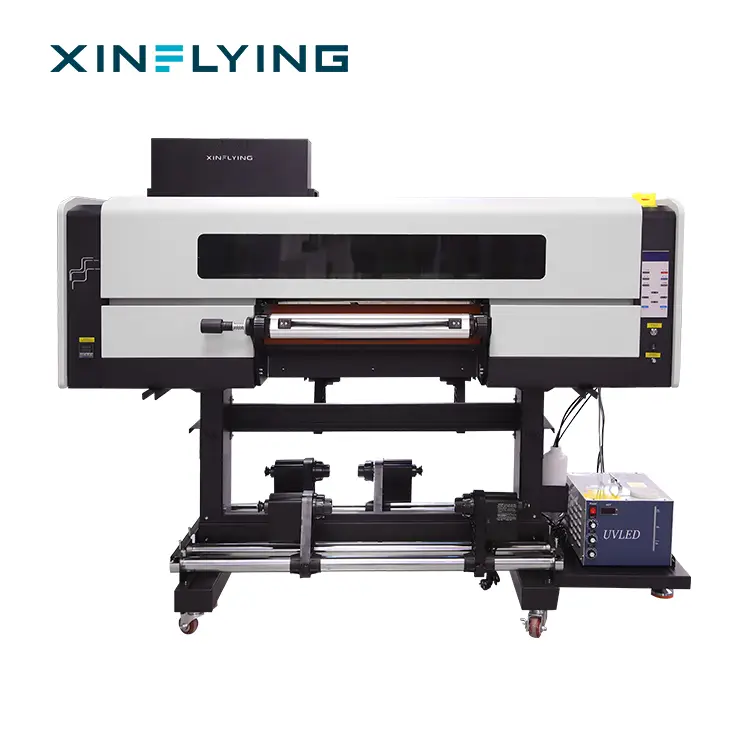
Xinflying’s XF-420S, for example, is equipped with Epson i1600-U1 printheads. Its official product information specifies four Epson i1600-U1 printheads, a 16.5-inch printing width, and an 8-pass printing speed of 3.5 m²/h.
The i1600-U1 specification listed by Xinflying includes 1,600 nozzles, eight nozzle rows, and an effective print width of 33.8 mm per printhead. Such technical characteristics provide buyers with a more meaningful basis for evaluating equipment than price alone.
Printing Width and Production Requirements
Printing width is another major consideration when comparing UV DTF equipment. A wider working area can be useful for businesses producing larger quantities of labels, stickers, and customized graphics, while a compact machine may better suit businesses with limited production space.
The XF-420S offers a 16.5-inch printing width and is positioned by Xinflying as a compact UV DTF solution for labels, stickers, and customized applications. Its 16.5-inch printing width provides a 420 mm-class working format for labels, stickers, and customized applications.
Production requirements should therefore guide purchasing decisions. A company producing frequent commercial orders may need to prioritize throughput, whereas a smaller customization operation may place greater value on flexibility and equipment versatility.
Automation Can Change the Overall Equipment Investment
Automation is another factor that can influence the UV DTF printer price. Features that reduce manual intervention can increase equipment complexity, but they may also help businesses streamline repetitive production steps.
The XF-420S includes a 7-inch touchscreen, automatic film peeling system, vacuum suction platform, printhead anti-collision protection, air-cooled UV curing lamps, and intelligent base plate heating. These functions are designed to support a more controlled and convenient production workflow.
For business buyers, automation should be evaluated according to labor requirements rather than treated simply as an added feature. If an automated function reduces handling time or helps maintain consistency across repeated orders, it may have practical value beyond the initial equipment cost.
Curing and Lamination Matter for Sticker Quality
UV DTF sticker production involves more than depositing ink onto film. Printing, curing, lamination, and transfer all contribute to the final result. Equipment configuration in these areas can therefore affect both machine cost and production performance.
Xinflying states that the XF-420S incorporates an integrated laminating system with a high-adhesion rubber roller. Its product page also specifies air-cooled UV curing lamps and describes the system as supporting strong adhesion and glossy finishes.
These functions are particularly relevant for businesses producing branded stickers, labels, promotional items, and customized products where appearance and transfer consistency influence customer expectations.
Integrated Functions Can Expand the Business Case
Equipment value can also depend on how many production applications a single machine can support. Xinflying positions the XF-420S as an integrated system combining UV DTF printing with 3D embroidery capabilities. This makes it relevant to businesses working across customized apparel, textile decoration, stickers, and promotional products.
The machine is designed for applications including custom patches, hat logos, shoe labels, and decorative UV stickers. For businesses serving multiple customization categories, combining functions in one production system may reduce the need to purchase separate equipment for every application.
Consider the Supplier Behind the Machine
A machine’s purchase price is only one part of the investment equation. Business buyers should also examine supplier support, technical assistance, training, spare-parts availability, and the broader product portfolio.
Xinflying identifies itself as a global digital printing supplier offering DTF, UV DTF, DTG, and sublimation printers, together with related consumables. Its website also highlights remote technical assistance, online training, overseas warehouses, and after-sales support for international customers.
For buyers researching a UV DTF printer manufacturer, these service capabilities can be important when assessing the practical cost of owning and operating equipment over time.
Making a More Informed UV DTF Investment
There is no single UV DTF machine configuration that suits every commercial application. Businesses evaluating the market should consider printhead technology, printing width, throughput, automation, curing and lamination systems, application range, and supplier support together.
The XF-420S demonstrates how these factors can be combined in one commercial solution, with four Epson i1600-U1 printheads, a 16.5-inch printing width, 3.5 m²/h output at 8-pass operation, and integrated UV DTF and 3D embroidery functions.
Rather than selecting equipment based solely on the lowest quoted UV DTF printer price, commercial buyers can compare configurations against their expected order volume, product range, labor requirements, and future expansion plans. This approach makes the equipment budget more closely connected to actual production needs.
