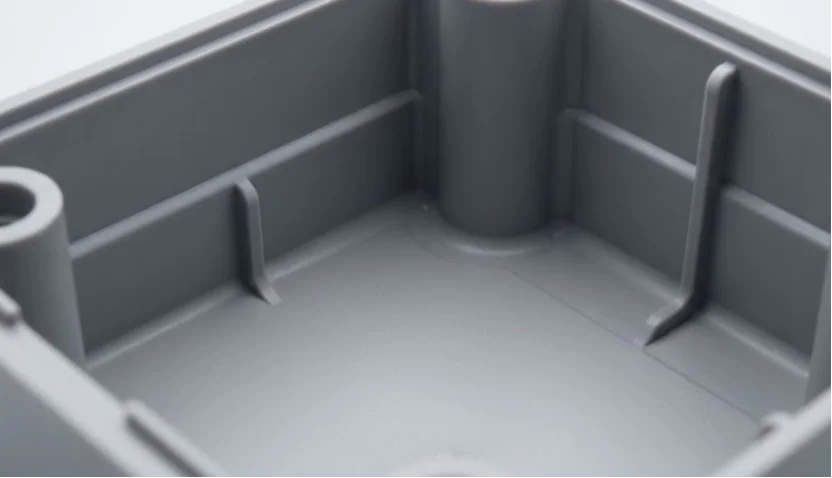
Engineers developing high-performance plastic housings often confront unexpected surface blushing and localized whitening during initial production runs. These visible defects indicate severe internal molecular disruption and uneven thermal shrinkage that compromise mechanical reliability under extreme operating loads.
Anticipating how polymer chains behave under high-shear flow is essential before cutting final production steel for custom molds. Addressing potential structural vulnerabilities during the initial design phase eliminates costly downstream redesign cycles and unexpected commercial field failures. Establishing robust prevention protocols ensures that manufactured plastic components maintain uniform mechanical properties throughout their lifecycle.
Modern manufacturing environments demand strict adherence to tight dimensional tolerances and flawless cosmetic finishes across every single molded batch. Neglecting microscopic structural anomalies during early prototyping phases frequently results in catastrophic component failures once products reach end-user deployment.
Technical teams must evaluate melt flow dynamics, thermal gradients, and pressure distribution parameters simultaneously to safeguard structural integrity. Proactive risk management transforms erratic shop-floor outcomes into predictable, highly repeatable industrial manufacturing workflows. Sourcing parts through reliable partners ensures absolute compliance with demanding engineering specifications.
Identifying the Root Causes of Molecular Disruption
Polymer chains stretch violently during cavity filling as molten material navigates narrow runner systems, sharp corners, and complex geometric transitions. If the leading edge of the polymer stream cools prematurely against cold steel walls, elongated molecular structures freeze permanently.
Injection molding stress marks frequently manifest as a direct consequence of this high-shear molecular orientation trapped near part surfaces. Recognizing these microscopic structural flaws requires more than simple visual inspection; polarized light analysis often reveals hidden stress concentrations. Failing to correct these underlying mechanical imbalances leads to premature cracking when assemblies experience operational stress in the field.
Material selection heavily influences how severely a thermoplastic compound reacts to rapid shear rates and localized pressure spikes during injection. Unfilled resins behave differently under thermal contraction compared to glass-filled or mineral-reinforced alternatives commonly used in heavy industrial enclosures.
Reviewing raw material technical datasheets helps technical teams select appropriate melt flow indices that minimize internal molecular friction. Matching polymer characteristics to specific cavity designs prevents unexpected blushing during high-speed production cycles. Continuous raw material verification protects overall product quality and ensures consistent physical performance across batches.
Designing Tooling Geometries to Prevent High-Stress Points
Component architecture heavily dictates how smoothly molten plastic distributes itself across core and cavity inserts during high-pressure injection cycles. Sharp internal corners act as severe stress concentrators that restrict smooth flow progression and encourage localized material tearing.
Incorporating generous radii and smooth transitions allows the polymer melt to flow evenly without creating violent shear friction. HordRT integrates advanced design-for-manufacturability workflows to evaluate complex geometry layouts prior to cutting metal inserts. Furthermore, optimizing gate dimensions prevents localized jetting and reduces the likelihood of severe surface blushing across finished parts.
Tooling engineers must also focus heavily on draft angle design and smooth surface finishing to facilitate seamless part extraction. Inadequate draft angles cause severe mechanical binding and friction against core surfaces during opening strokes, leaving pale halos.
Increasing draft angles and distributing ejection forces across wider surface areas prevents surface marring and micro-fissure formation. Precision CNC machining centers execute these intricate geometric details with micron-level accuracy, ensuring flawless parting line seals. Meticulous tool preparation establishes a solid foundation for flawless physical manufacturing processes.
Fine-Tuning Thermal and Pressure Profiles for Structural Stability
Thermal management plays a decisive role in controlling how rapidly polymer chains relax after the mold cavity achieves complete filling. Cold mold surfaces accelerate cooling rates unevenly across varying wall thicknesses, trapping destructive thermal contraction stresses inside manufactured parts.
Elevating barrel and mold temperatures improves fluid viscosity, giving molecular structures adequate time to settle before final solidification occurs. Monitoring holding pressures prevents excessive packing forces from driving unnecessary material volume into closed cavities. Balancing these thermal and pressure parameters eliminates cloudy tension lines and prevents injection molding stress marks from ruining cosmetic finishes.
Cooling channel efficiency directly influences thermal uniformity and residual stress distribution throughout molded structural enclosures and multi-cavity tools. Blocked or poorly designed cooling lines create localized hot spots that delay solidification in thick wall sections and cause warping.
Cleaning mineral buildup from thermal management systems restores balanced heat transfer across both core and cavity halves. Uniform thermal dissipation minimizes localized shrinkage differentials that generate hidden internal tension lines. Proactive thermal maintenance guarantees stable cycle times and repeatable component quality over millions of shots.
Verifying Component Resilience Through Rigorous Quality Standards
Comprehensive quality validation is mandatory to ensure that molded components meet stringent industrial durability requirements before commercial distribution begins. Technicians utilize advanced metrology equipment and non-destructive testing methods to verify dimensional stability and internal structural uniformity across batches.
HordRT implements rigorous inspection checkpoints during every phase of production to detect hidden micro-fissures or residual strain concentrations early. Documenting parameter logs and material compliance certificates guarantees complete traceability for demanding automotive and industrial applications. Injection molding stress marks serve as valuable visual indicators that guide ongoing process optimization and continuous quality improvement initiatives.
Partnering with HordRT gives engineering teams access to technical expertise that can help identify potential structural issues, reduce defect risks, and improve manufacturing quality. By addressing complex manufacturing challenges through appropriate engineering analysis and process optimization, teams can support product reliability and work toward meeting customer expectations in competitive global markets.
Rigorous inspection protocols provide absolute visibility into critical dimensional tolerances before parts leave the facility floor. Forward-thinking organizations leverage professional manufacturing partnerships to accelerate time-to-market milestones while maintaining uncompromised hardware quality. Continuous improvement frameworks empower enterprises to outpace competitors and lead their respective industries reliably.
