In manufacturing environments, lifting risks are not limited to heavy loads. Components that weigh only a few kilograms may still need to be moved repeatedly throughout an eight hour shift. When operators frequently lift, position, rotate, or transfer these items manually, even relatively light loads can contribute to fatigue, awkward postures, and repetitive strain.
This is why modern material handling strategies increasingly focus on ergonomics as well as lifting capacity. The right crane components can help reduce unnecessary manual handling while making repetitive workstation tasks more controlled and consistent. For facilities handling small parts, tools, fixtures, or assemblies, a properly selected lifting system can support both operator comfort and production efficiency.
Why Light Loads Can Become an Ergonomic Problem
The weight of an individual load does not tell the entire story. Frequency, lifting height, reach distance, movement speed, and working posture can all influence the physical demands placed on an operator.
A five kilogram component may appear easy to handle once or twice. However, moving the same component dozens or hundreds of times during a shift creates a very different workload. Reaching across a workstation, lifting an object from below waist level, or holding a load away from the body can increase physical strain.
Manufacturers therefore need to consider how materials move through a workstation rather than focusing only on maximum load capacity. This is where ergonomic light load lifting systems can provide practical support.
How Light Duty Overhead Cranes Support Workstations
A light duty overhead crane can provide an overhead lifting path for repetitive handling tasks without taking up additional floor space. Instead of asking operators to repeatedly carry components manually, the lifting system can support controlled vertical and horizontal movement.
These systems can be useful around assembly stations, maintenance areas, tooling workstations, and material transfer points. Their relatively compact configuration also makes them suitable for facilities where available workspace is limited.
However, a light duty crane should not simply be selected according to the lowest possible rated capacity. Engineers should consider the actual working load, lifting frequency, travel distance, available headroom, workstation layout, and expected operating environment.
The objective is to create a lifting system that fits the task rather than installing equipment that is unnecessarily large or difficult to operate.
Choosing the Right Crane Components
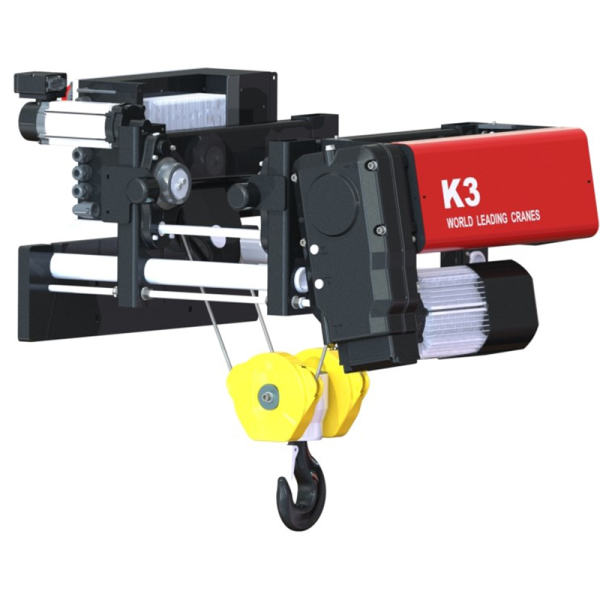
A lifting system is made up of several interconnected elements, and each component can affect overall performance. Hoists provide vertical movement, while trolleys and end carriages allow loads to travel through the required working area. Motors, gearboxes, controls, hooks, and lifting attachments complete the system.
For light material handling, the hoist should provide sufficient capacity without introducing unnecessary size or complexity. A suitable light-duty hoist for industrial use should also provide controlled movement that allows operators to position loads accurately.
Gearmotors are another important consideration. Appropriate motor and gearbox selection can help provide smooth travel and controlled acceleration. This can be particularly useful at workstations where operators need to position components carefully rather than move them rapidly over long distances.
The compatibility of these crane components should also be evaluated during the design stage. Matching the hoist, trolley, supporting structure, drive system, and controls can help simplify installation and future maintenance.
Designing a Small Capacity Crane Lifting Solution
A small capacity crane lifting solution should be designed around the actual workflow. Before selecting equipment, manufacturers should identify what is being lifted, how often it is moved, where it starts and ends, and how much operator interaction is required.
Workstation dimensions are equally important. The crane should provide enough coverage to reach the necessary handling points while avoiding interference with machinery, lighting, ventilation systems, and other overhead equipment.
Headroom can also influence component selection. A compact hoist or suitable trolley arrangement may help preserve usable lifting height when the building structure provides limited clearance.
Another consideration is control. If an operator needs to position a component precisely, smooth and predictable movement can be more useful than simply having a higher lifting speed. The lifting system should match the precision and frequency requirements of the application.
Reducing Manual Handling Without Overengineering
One common mistake is assuming that ergonomic improvement requires a large crane system. In reality, many workstation applications require relatively modest lifting capacity but frequent and precise movement.
Using appropriately sized equipment can provide ergonomic assistance while keeping the system practical for the available space. It can also avoid introducing unnecessary structural loads or equipment that is difficult for operators to use.
At the same time, manufacturers should avoid selecting components based solely on the nominal load. A system handling a 20 kilogram assembly may experience different demands depending on how frequently the load is lifted and how far it travels.
A proper assessment should therefore consider rated capacity, duty cycle, lifting height, travel speed, installation conditions, and maintenance requirements together.
Making Light Load Handling Safer and More Practical
Light loads should not automatically be treated as low risk. When small components are lifted repeatedly, poor workstation design and excessive manual handling can gradually increase operator fatigue and affect productivity.
A well designed lifting system addresses these challenges by matching crane capacity, component selection, movement requirements, and workstation layout. The goal is not to install the largest available crane, but to create a practical handling solution that fits the work being performed.
For manufacturers evaluating crane components, WORLDHOISTS provides options that can support different lifting configurations, including applications where compact equipment and controlled movement are important. By considering ergonomics, equipment compatibility, duty requirements, and maintenance from the beginning, facilities can develop lifting systems that support more efficient and sustainable workstation operations.
